The 200th anniversary of the world’s first passenger rail service between Stockton and Darlington in 2025 seemed an appropriate time to consider what the railways have meant to me. This is not a travelogue of memorable journeys I’ve made by train, but rather a family history, a summary of some studies that I’ve done and a near-death experience.
In the Blood
I have had very strong family connections to the railways. My father was a fireman on steam locomotives, a train driver and railway supervisor, my grandfather the station master at Finsbury Park in London and my uncle the manager of Kings Cross rail freight depot in London. I too was on track to enter the railway industry. As a student I had summer jobs in a freight marshalling yard and two railway stations (Perth and Aberdeen). I successfully applied twice for graduate jobs in British Railways management, though on both occasions, after much reflection, opted instead for academic alternatives. A career in universities still gave me the opportunity to conduct numerous studies of the railways and do much else besides.
A Near Death Experience
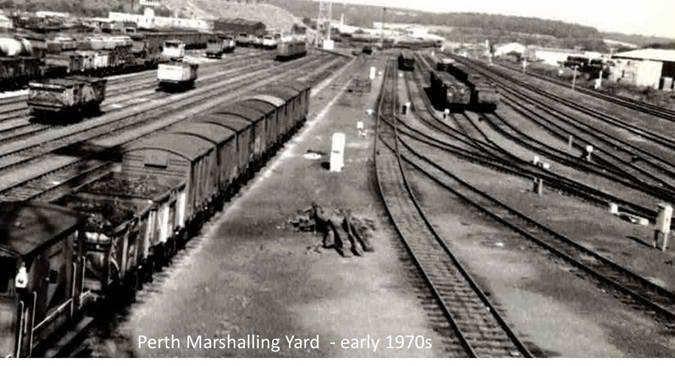
During a summer job as the Advance Traffic Information (ATI) Clerk in Perth Marshalling Yard in the summer of 1971 a rail wagon almost ended my life before I even went to university. Long before the manifests of freight trains were computerised and transferred electronically between terminals, clerks had to walk the length of a train jotting down information from cards clipped to the sides of wagons, about their origins and destinations, contents, consignors etc. This was then ‘phoned through’ to the next marshalling yard en route. All very primitive by today’s standards.
The marshalling process involved sorting individual wagons into trains destined for particular yards. This was done by allocating them to different sidings, a process controlled by ‘shunters’ whose job it was to couple the wagons into a train. The sidings in the Perth yard were long enough to accommodate a train of twenty to thirty wagons. If you’ve never seen a mashalling yard in operation, this video will give you a sense of what’s involved. On the day in question, one of my ATI forms had blown onto an adjoining siding. I went to pick it up not noticing that a train was about to be built in that siding. The first wagon was already hurtling in my direction round a curved section of track and would have crushed me within a few seconds had one of the shunters not yelled to me to get out of the way. I reacted rapidly enough to survive and head off to university a few weeks later.
Immersed in Railway Timetables
During my university studies in geography I came across research by an American professor called Donald Janelle on spatial patterns of acceleration across transport networks. He devised the concept of time-space convergence, where ‘convergence is expressed as the rate at which the travel-time between places has been declining’. For my undergraduate dissertation I used this framework to analyse the acceleration of rail services across the Scottish rail network between 1950 and 1974. This involved poring over dozens of old train timetables in Scottish Register House, Edinburgh, a rather tedious and mind-numbing exercise. I found that over the quarter century passenger services had accelerated by an average of 25% and freight movements by 32%, with wide variations in the rate of ‘time-space convergence’ by route and region. In the intervening years, however, many lines had closed depriving the communities they served of access to these faster services.
Channel Tunnel Over-optimism
In 1989 I was invited to join the Freight Working Group set up in accordance with Section 40 of the Channel Tunnel Act to examine ways of maximising the benefit to Scotland of international freight train services through the Tunnel. Our report, published five years before the Tunnel opened in May 1994, was optimistic, seeing the new link as giving rail the opportunity to exploit its long-haul advantage on journeys from one of Europe’s most peripheral regions to its industrial heartland. It forecast that 392,000 tonnes of freight would use ‘through-rail’ services annually between Scotland and mainland Europe (in both directions). Shortly afterwards I was appointed Special Advisor to the Scottish Affairs Committee of the House of Commons for its Inquiry into ‘The Future of Scotland’s Transport Links with Europe’. This too investigated the potential for international rail freight services and came to a similarly positive conclusion. In addition to writing half of the Committee’s report, I published a more detailed journal paper on the subject again fairly upbeat about the prospects for Scotland-EU rail freight. I concluded that ‘it seems likely that Scotland will generate enough European freight traffic to support at least one train of intermodal units a day’. Sadly, we were all wrong. Almost thirty years later, in 2023, a mere 1.6% of the goods moving through the Tunnel were on freight trains and precious few of them had an origin or destination in Scotland!
‘More on the Side’
My first ever publication, in Geographical Magazine in 1981, had this rather intriguing, vaguely naughty, title. It was about the use of disused railway land for industrial and warehouse development. One of rail’s big problems in competing with road for freight traffic has been the much lower density of its network. A way of dealing with this geographical disadvantage was to lure commercial premises to rail-side locations, effectively reversing long term trends in the spatial distribution of industrial and logistics capacity in the UK. This would allow them to take advantage of so-called Section 8 grants made available by the government to subsidise the installation of sidings to premises near rail lines. It was a good idea at the time, but regrettably didn’t ‘deliver the goods’. Much of the available rail-side land was subsequently used for other purposes, mainly housing, retailing and offices, while it proved uneconomic for train operators to move small numbers of wagons to and from rail-connected factories and warehouses, except where they were large enough and/or clustered in industrial estates.
‘Trucking Hell’
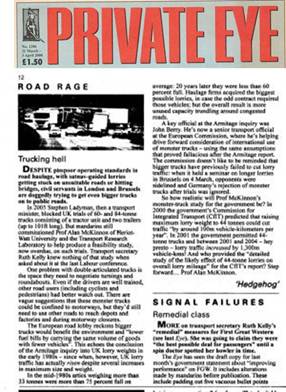
Given my family background and early research on train services, some of my subsequent work no doubt smacks of disloyalty to the cause of getting more freight onto the railways. My first transgression was in conducting a cost-benefit analysis of the case for increasing maximum lorry weight in the UK from 41 to 44 tonnes. I was asked to do this by the Commission for Integrated Transport in 1999 which was advising the Secretary of State for Transport, John Prescott, on the issue. This was a regulatory change strongly opposed by rail freight companies and the wider rail lobby as they saw it reducing the relative cost of road haulage and creating unfair competition. My report, however, concluded that relaxing the maximum lorry weight would yield significant economic and environmental benefits. This formed the basis of Prescott’s subsequent decision to allow 44 tonne lorries on Britain’s roads. Data that I collected for a follow-up study four years later suggested that, if anything, I had under-estimated the benefits and found there had been little or no erosion of freight traffic from rail to road. Some in the rail lobby, however, didn’t forgive me and I suspect that one of its members may have been behind a Private Eye article in 2008 entitled ‘Trucking Hell’ which pilloried me for my research on the lorry weights and dimension issue. Perhaps in the light of longer-term efforts to increase rail’s share of the freight market, it would have been better if I hadn’t got out of the way of that wagon hurtling towards me back in 1971!